
Installing a private pool or a balcony pergola has become very common in recent years, in private homes, rooftop apartments, penthouses, and commercial buildings. These additions significantly enhance both quality of life and property value, but alongside their benefits it is important to remember that any addition to a structure creates an engineering impact that must be assessed professionally.
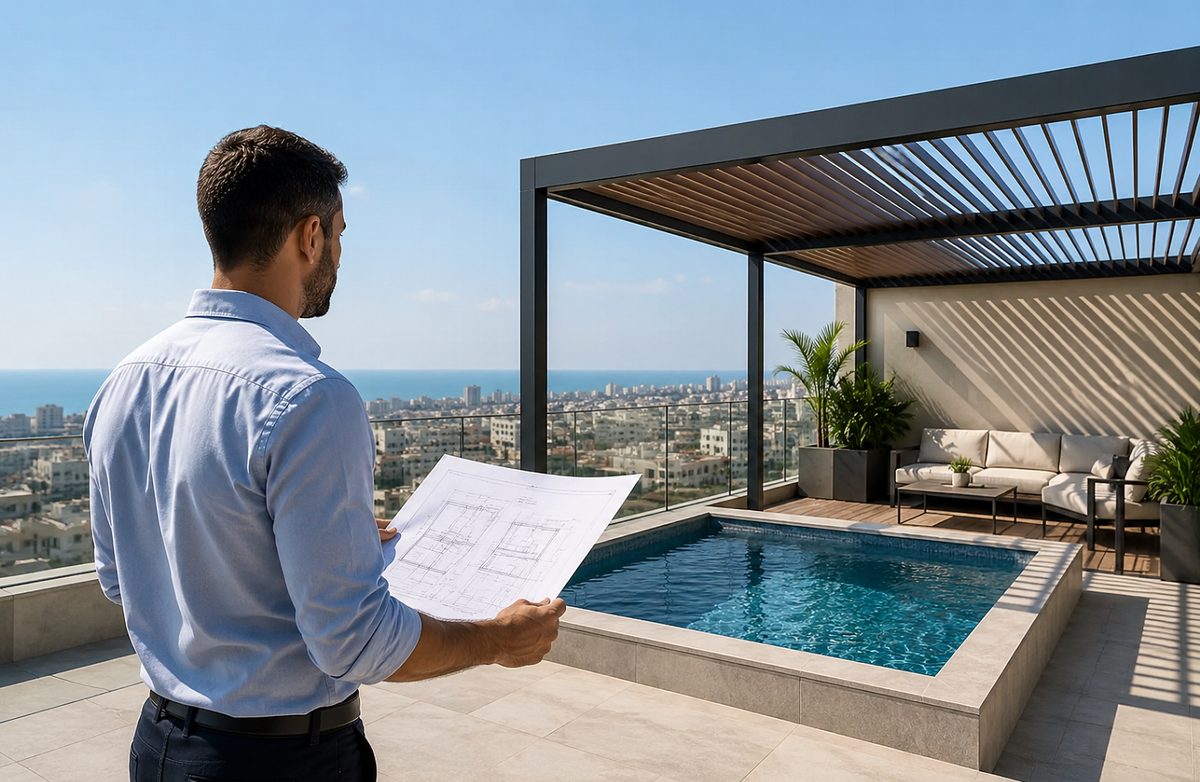
Many people tend to regard a pool or pergola as a purely decorative element, yet from a structural standpoint these are installations that can impose significant loads on the building. In many cases a pool safety certificate, a pool safety approval, or a balcony pergola approval is required, in order to verify that the structure can safely carry the loads and that the installation can be carried out in accordance with accepted engineering requirements.
This is where the structural engineer comes in – the structural engineer responsible for assessing the building’s stability, performing engineering calculations and issuing the required approvals according to the characteristics of the project.
When people think about a private pool, most focus on its size, design, and location, but far less on the enormous weight it creates. Water is an exceptionally heavy material, and every cubic meter of water weighs about one ton. This means that even a relatively small home pool can add a load of several tons to the structure.
When the pool is installed on a roof, a balcony, or a raised platform, you need to examine whether the slab, the beams, the columns, and the rest of the structural skeleton were designed to carry such a load over time. Beyond the weight of the water itself, you must also account for the weight of the pool, the accompanying equipment, the users, and the forces generated by the movement of the water.
We often meet property owners who are surprised to learn that even an above-ground pool or a fiberglass pool requires an engineering inspection. The reason is simple: from the building’s standpoint, what matters is the total load, not the type of pool.

A pool safety certificate is an engineering document issued by a structural engineer after examining the relevant data and performing professional calculations. The purpose of the certificate is to verify that the structure can safely carry the pool and that its installation does not endanger the stability of the building or the people using it.
The inspection examines, among other things, the building plans, the pool’s location, the expected loads, and the structural condition of the property. In certain cases, a site visit will also be required in order to accurately assess the conditions on the ground.
This certificate may be required by local authorities, insurance companies, installation companies, and building committees, and even by the property owners themselves, who want to make sure the project is carried out safely and responsibly.
One of the common mistakes is the assumption that only large or public pools require the involvement of a structural engineer. In practice, even private pools intended for family use may create significant loads.
This is especially true when the pools are located on roofs, on balconies, in penthouses, or in areas where the building’s load-bearing capacity is limited. In these cases, an early engineering inspection can prevent unnecessary risks and save substantial costs down the line.

Like pools, pergolas too are sometimes seen as a relatively simple addition. In practice, every pergola that connects to a building affects the loads acting on it and the way it behaves in different weather conditions.
Modern pergolas, and especially large aluminum pergolas or pergolas that include glass roofing, can impose significant loads on the balcony and on the connection points to the building. In addition, you must take the effect of wind into account, particularly in tall buildings and in penthouses that are more exposed to the elements.
Therefore, before carrying out the installation, it is important to make sure the pergola is properly designed, that its connections to the building are suitable, and that there is no harm to stability or safety.
In many projects, a structural engineer’s approval is required as part of the planning or permitting process. The purpose of the approval is to verify that the pergola was designed in accordance with accepted engineering principles and that the structure is capable of supporting it for years to come.
The structural engineer examines the type of pergola, the anchoring method, the building materials, the installation location, and the expected loads. Based on the findings, the engineer provides an engineering approval and sometimes also instructions for execution or reinforcement as needed.
Beyond the requirements of the authorities, a professional approval gives the property owner peace of mind and the assurance that the system was designed in a safe and responsible manner.
The inspection process usually begins with collecting the existing data about the structure and reviewing the relevant plans. The required engineering calculations are then performed according to the type of pool or pergola and the characteristics of the structure.
In certain cases, a site visit is also carried out in order to physically inspect the structure and assess its actual condition. After completing the checks, the structural engineer prepares the required documents and approvals and accompanies the project as needed.
When the inspection is carried out at the very beginning of the process, engineering limitations can be identified in advance, preventing delays, costly changes, or safety problems later on.
Inspections and approvals of this kind require a combination of design knowledge, practical experience, and familiarity with standards, construction methods, and the requirements of the authorities. Beyond the calculations themselves, it is highly important to understand the behavior of different structures and to be able to identify risks that are not always visible to the eye.
BRN Engineering (B.R.N. Engineering Ltd.) supports private clients, architects, developers, and contractors on a wide range of projects across the country. The firm specializes in structural design, engineering opinions, building stability inspections, and the issuing of engineering approvals for a variety of purposes.
Thanks to accumulated experience across numerous projects, in-depth familiarity with the requirements of the authorities, and the ability to provide nationwide service, BRN Engineering offers its clients a professional, fast, and personal response throughout the entire process.
A pool and a pergola are wonderful additions that can significantly upgrade any property, but before you begin the work it is important to make sure the structure can indeed carry them safely. A professional inspection by a structural engineer and an appropriate engineering approval are not merely a technical requirement in certain cases – they form an important layer of protection for the safety of the users and for the integrity of the building over the years.
Professional support from the earliest planning stages makes it possible to make the right decisions, avoid surprises, and carry out the project with complete peace of mind and confidence.
From an engineering standpoint, what matters is the total load, not the size of the pool. Pools installed on a roof, a balcony, or a raised platform, as well as above-ground and fiberglass pools, can create a load of several tons. It is therefore advisable to carry out an engineering inspection and obtain a pool safety certificate before installation.
A pool safety certificate is an engineering document based on an examination of the building plans, the pool’s location, the expected loads, and the structural condition of the property, and sometimes also on a site visit. Its purpose is to verify that the structure can safely carry the pool and that the installation does not compromise the building’s stability.
In many projects a structural engineer’s approval for a pergola is required as part of the planning or permitting process, especially for large aluminum pergolas or pergolas with glass roofing. The engineer examines the type of pergola, the anchoring method, the connections to the building, and the expected loads, including wind loads in tall buildings.
The approvals may be required by local authorities, insurance companies, installation companies, and building committees, as well as by the property owners themselves, who want to make sure the project was carried out safely and responsibly.
It is advisable to involve a structural engineer as early as the initial planning stages. An early inspection makes it possible to identify engineering limitations in advance, prevent delays and costly changes, and ensure that the installation is carried out safely and in accordance with the requirements.